Our Spotlight Report is where you will find the legislator ratings, and the link is in the above menu.
Legislator Ratings
Who Can You Trust?

307 Votes endeavors to bring you a simple method of rating Wyoming legislators to aide you in determining who you can trust to uphold their Oath of Office. Legislator rankings consist of three trust levels; High, Limited, and Low.
Click on our Spotlight Report to see your legislator’s ranking. Find your legislator’s name alphabetically or use the County drop-down menu. Click on their picture and begin reading – you can read as much or as little as you want by clicking on the tabs.
You can also use the additional drop-down menus to view Trust Level groups, or sort by Senators, House Representatives, Republican’s or Democrats.
What Inspired Our Trust Ranking System?
The United States Constitution and Wyoming Constitution are the bedrock for the best government and governance that our Founders could conceive. This is why both constitutions are at the center of the Oath of Office. The Oath of Office is not only the the solemn promise that every elected official must swear before taking office – it is the citizenry’s job to hold them to that Oath after they take office. In other words, do you trust them to abide by their Oath of Office?
Wyoming State Constitution Article 6, Section 20.
Oath of office; form.
Senators and representatives and all judicial, state and county officers shall, before entering on the duties of their respective offices, take and subscribe the following oath or affirmation:
“I do solemnly swear (or affirm) that I will support, obey and defend the constitution of the United States, and the constitution of the state of Wyoming; that I have not knowingly violated any law related to my election or appointment, or caused it to be done by others; and that I will discharge the duties of my office with fidelity.“
We do not claim that our Trust Ranking System is perfect. We review a great deal of publicly available data and records and make determinations to the best of our ability, and as objectively as possible. Ultimately everything is compared to a legislator upholding their Oath of Office. We believe this is critical information that every Wyomingite should have access to every day of the year, and not just during election season when mailboxes fill up with campaign flyers.
How Our Ranking System Works
- High Trust – We believe legislators with this ranking uphold their Oath of Office most of the time.
- Limited Trust – We believe legislators with this ranking uphold their Oath of Office some of the time.
- Low Trust – We believe legislators with this ranking seldom uphold their Oath of Office. They either do not comprehend, or perhaps do not care about, their proper role in a constitutional republic.
How we rank legislators:
- High Trust = 3 pluses (+ + +)
- Limited Trust = 2 pluses (+ + –)
- Low Trust = 1 or 0 pluses (+ – –) or (– – –)
The final ranking of each legislator occurs in their Summary, which is the first tab on their page.
How we score legislators:
Legislators receive a simple plus ( + ) or minus ( – ) score in each of the following three categories. These categories are seen as the next three tabs on each legislator’s page:
- Representation
- Competence
- Integrity
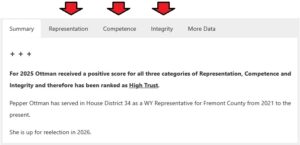
There is one last tab labeled “More Data” to add any additional data we think relevant or of interest.
REPRESENTATION
Representation is evaluated by how a legislator conducts themselves while representing their constituency.
Attendance: Having a reliable record of vote attendance during legislative sessions proves when legislators are present to vote (and debate when necessary), thereby properly representing their constituents. The opposite is also very important – some legislators are known for skipping votes so that there is no vote record that constituents can hold them accountable for – especially in election years, and for controversial bills. Thus we believe a complete vote record is crucial.
The way we gather our vote records is by going through the Bill Digest of every single bill during a session, and precisely note who was present, who was absent and who might have recused themselves. There is however two issues:
1) The Wyoming legislature traditionally counts every missed session vote as “Excused”. There is no recorded differentiation between absence because of illness, or absence because they simply walked out of the room. We have no control of this, and it is impossible to know who was absent for a legitimate reason.
2) The second issue is sometimes a legislator might be presenting a bill for a committee elsewhere or serving in a special/concurrence committee – they simply cannot be in two places at once. In this case we can offer a solution to any legislator who feels the vote record we have for them is incorrect. We encourage them to contact us with the necessary details to reasonably clarify why they missed certain votes.
Attendance perimeters: A legislator must be present for all votes on 90% of the days of any legislative session. For example, both 2025 and 2023 Regular Sessions had 37 days. Therefore a legislator had to be present for, and vote on all bills, for any 33 days. Put another way, if a legislator missed any votes on 5 or more days, they receive a negative (–) score.
Public Conduct: A legislator must behave appropriately in public and to the public. Intentional disrespect and rudeness to a citizen or to a fellow legislator is inappropriate. While this doesn’t occur very often, misuse of taxpayers’ dollars for travel or misuse of office while traveling is also an infraction.
Violations of Oath of Office: Sponsorship of any unconstitutional bills or bills that are a personal conflict of interest are violations of the Oath of Office (Wyoming State Constitution Article 6, Section 20).
An infraction in any of these areas earns a negative score (-) for Representation.
Additional information provided under the Representation tab includes a brief summary of Bill Sponsorship History and Committee Assignments.
COMPETENCE
A legislator’s competence is graded on how they vote on bills that can affect constitutional rights and/or constitutional provisions enumerated in both our federal and state constitutions.
Bills that support, obey or defend constitutional provisions, require an “Aye” vote. An example would be most Second Amendment bills.
Other bills can have a negative effect by violating or ignoring constitutional provisions, in which case those bills require a “Nay” vote. Below are some examples:
- Treatment Court bills (SF0023 from 2023, and SF0160 from 2025). While both those bills intended to solve legitimate substance abuse and mental healthcare issues in Wyoming, both bills also violate fundamental separation of powers provisions in both our federal and state constitutions. Legislators who voted Aye on those bills (both passed) either failed to realize, or chose to ignore, that the separation of powers is constitutionally mandated by both constitutions. (More info on that here.)
- SF0022 Ground for termination of parental rights-guardianship from 2025 was sponsored (and passed) to address legitimate concerns for (usually) grandparents who are raising their grandchildren because the parent(s) are incapable of providing a healthy, stable life for their children for a number of reasons. The intention of the bill to support guardians was valid and good, but the bill actually violates the 8th Amendment of the United States Constitution and Article 1, Section 14 of the Wyoming Constitution. (More on SF0022 can be found here.)
Every general session constitutionally related bills are grouped into numbered categories. Using a scorecard, a legislator’s vote is recorded for each bill in each of those categories:
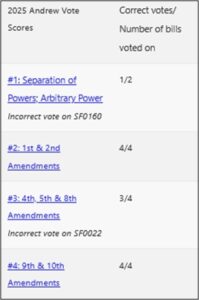
On the scorecard, each category has a numeric value: The bottom number is how many bills the legislator voted on in that category, and the top number is how many of those bills they voted constitutionally correct on. For example, as shown in the image above, if they voted incorrectly on one of two bills in group #1, their score would show as 1/2. If they voted correctly on all four bills in Group #2, their score would show as 4/4.
The total number of bills the legislator has voted on are divided by the number of bills they voted correctly on. The final value is computed as a percentage. Legislator’s must have a percentage of 85% or higher to receive a final positive (+) score for Competence.
At times a legislator might be absent for a vote. In those cases, that bill is not counted on the legislator’s scorecard. Legislators are only graded on bills that they actually voted on.
INTEGRITY
Integrity is generally defined as the quality of being honest and having strong moral principles. We consider the integrity of a lawmaker by examining what they do when they assume no one is paying attention.
1) Have they voted on any bills they have a conflict of interest with?
Wyoming State Constitution Article 3, Section 46 – Interested member shall not vote
A member who has a personal or private interest in any measure or bill proposed or pending before the legislature shall disclose the fact to the house of which he is a member, and shall not vote thereon.
NOTE: We have found no history of Legislative Leadership holding a legislator accountable for violating Wyoming State Constitution Article 3, Section 46. Thus, there is no accountability for conflicted legislators and their actions. This is a significant problem that citizens need to be aware of and address.
2) Any constitutional violations the legislator was willing to subjugate WY citizens to by sponsoring unconstitutional bill(s).
3) Do they fail to disclose business entities, state contracts or directorships that might create conflicts of interest?
Any infractions with these issues will receive a negative (-) score.
Information we provide for WY citizens under the Integrity tab includes:
- Conflicts – any that we find.
- Employment/Income (reported on their mandatory State Elected Officials Financial Disclosures)
- Memberships/Civic Organizations
- Campaign Contributions (publicly available records obtained directly from Wyoming’s Campaign Finance Information System)
More Data Tab
Currently we provide a spreadsheet that details each legislator’s travel reimbursements for 2025.
NOTE:
The information we provide on any legislator might change if we find, or are provided with, additional details in regards to conflict(s) of interest, vote records, etc. In such cases the new info will be acknowledged at our ‘Updates’ page and the appropriate changes recorded at the legislator’s page.
Senators and Representatives
We currently have 93 legislators; 31 Senators and 62 Representatives. Our staff endeavors to accurately report the findings of the legislators rated on our site, and provide the sources for your further reading and research. This takes time, so please bear with us as we continue compiling information. As such, please visit our site frequently to see the latest updates, and please share our site too. The more informed voters are, the better results for Wyoming, and Wyomingites,